
ENGINEERING NOTES / COST
Heroku, Render & Vercel Alternatives for Scaling Startups (2026 Cost Guide)
Managed PaaS (Heroku, Render, Vercel) is the cheapest option when your bill is small and your team is tiny. It becomes the most expensive option once you cross roughly $2,000/month in platform spend, because you're paying a 3–10x markup on raw compute for convenience you eventually outgrow. The best alternatives in 2026 are AWS ECS/Fargate or Cloud Run (the moderate step) and managed Kubernetes — EKS, GKE, AKS (the full step), ideally run for you so you don't trade a platform bill for a hiring problem.
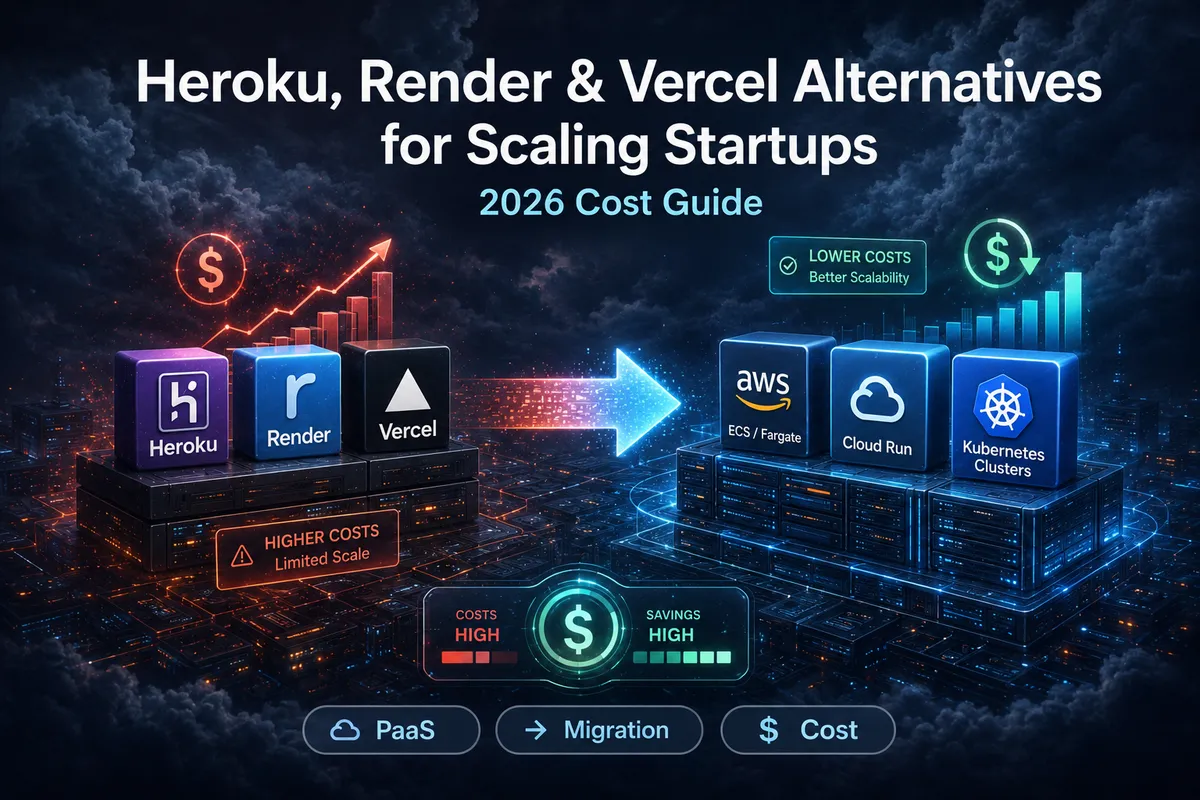
Short answer: Managed PaaS (Heroku, Render, Vercel) is the cheapest option when your bill is small, and your team is tiny. It becomes the most expensive option once you cross roughly $2,000/month in platform spend, because you’re paying a 3–10x markup on raw compute for convenience you eventually outgrow. The best alternatives in 2026 are AWS ECS/Fargate or Cloud Run (the moderate step) and managed Kubernetes — EKS, GKE, AKS (the full step), ideally run for you so you don’t trade a platform bill for a hiring problem.
This guide gives you the actual numbers, the decision threshold, and the migration path.
Why teams start looking for a Heroku or Render alternative
The trigger is almost always one of three things:
- The bill crossed a psychological line. A Heroku Performance dyno runs $250/month each, and a comparable 2GB web service on Render is around $25/month — but multiply either across web + worker + staging + add-ons and PaaS spend compounds fast.
- You hit a black-box ceiling. You can’t SSH to the host, tune the load balancer idle timeout, attach an eBPF probe, or run a sidecar. Support says “that’s not configurable.”
- Compliance arrived. SOC 2, HIPAA, or PCI-DSS need network isolation (VPCs), audit logging, and data residency controls that PaaS only sells on expensive enterprise tiers.
If none of these is true for you yet, stay on PaaS — it’s the correct, boring choice. The rest of this article is for teams where at least one is.
The 2026 PaaS cost reality
PaaS pricing isn’t linear; you pay a markup for abstraction. Here’s how the platforms compare on a simple production app (web service with ~2GB RAM):
| Platform | Comparable service (~2GB) | Notes |
|---|---|---|
| Heroku | ~$250/mo (Performance dyno) | Add-ons (Postgres, Redis, metrics) billed separately; no free tier since 2022 |
| Render | ~$25/mo (2GB web service) | Fixed instance pricing; scales more linearly than Heroku |
| Vercel | Usage-based | Excellent for frontend/edge; backend + bandwidth costs climb sharply at scale |
| AWS Fargate (raw) | ~$35–60/mo | Inside your VPC; you write the IaC (or have it managed) |
The markup that’s invisible at $500/month becomes brutal at scale. At $50,000/month of PaaS spend, a 3–4x markup is the equivalent of burning two senior engineers’ salaries on convenience alone.
Rule of thumb: Below ~$2k/month, PaaS markup is cheaper than the engineering time to replace it. Above it, the ROI of owning your infrastructure usually flips.
The best Heroku / Render / Vercel alternatives in 2026
1. AWS ECS + Fargate (or Google Cloud Run) — the moderate step
This is the natural next step off PaaS without committing to Kubernetes. You still run containers (just like your dyno), but inside your own VPC.
- Pros: Much cheaper compute, full networking control, standard IAM, no orchestration learning curve.
- Cons: You have to write Terraform and own the pipeline.
- Best for: Teams whose topology is “a few services + a database,” not a microservices mesh.
2. Managed Kubernetes — EKS / GKE / AKS — the full step
Go here when you need the ecosystem: Helm charts, operators, custom autoscaling, service mesh, multi-environment GitOps.
- The control-plane cost is small — an EKS cluster’s control plane is about $74/month ($0.10/hr). The real cost is operational expertise.
- Watch the extended-support trap: staying on an old Kubernetes version pushes EKS control-plane cost to $0.60/hr (~6x). Version hygiene matters.
- Best for: Teams that will run many services, need fine-grained scaling, or have compliance/multi-cloud requirements.
3. Self-hosted IaC-managed infrastructure — the cost-optimized step
Spot instances, Savings Plans, right-sizing, and multi-AZ redundancy, all codified in Terraform. This is where the 20–60% savings versus PaaS come from — and where most teams need help, because the savings are real but the operational burden is too.
The hidden trap: you don’t have a PaaS problem, you have an ops problem
Here’s the mistake teams make: they migrate off Heroku to “save money,” then quietly spend more — because now they need someone to run the cluster, patch the nodes, handle the 3 AM page, and keep the pipeline green.
A fully-loaded DevOps engineer in the US costs roughly $150,000/year in total compensation. If migrating off PaaS forces a hire, your $30k/year of platform savings just became a $150k/year cost.
This is exactly why managed DevOps exists. The goal isn’t “PaaS or self-hosted” — it’s getting the lower-cost infrastructure without taking on the headcount. You keep your engineers shipping product; the cluster, the upgrades, and the on-call belong to someone else.
A simple decision framework
Stay on PaaS if:
- Platform spend is under ~$2k/month
- Your app is a handful of stateless services + a managed database
- You have no dedicated DevOps capacity and no compliance pressure
- Time-to-market matters more than unit economics right now
Start planning a migration if:
- Platform spend is over ~$2k/month and climbing
- You’ve hit a configuration ceiling you can’t get past
- SOC 2 / HIPAA / PCI-DSS is on the roadmap
- Bandwidth or data-transfer charges are a meaningful line item
What a safe migration actually looks like
- Lift-and-shift to ECS/Fargate or Cloud Run — containers in your VPC, minimal rewrite.
- Move the data layer carefully — the hard part. Read replicas or CDC (change-data-capture) tooling, a secure sync window, then a controlled cutover. Rollback-first design, with checksums and row-count validation.
- Adopt Kubernetes only if you need the ecosystem — not by default.
Done right, the cutover is zero-downtime and reversible at every step.
How Agrohi helps
We migrate teams off expensive PaaS to IaC-managed infrastructure that costs 20–60% less — and then we run it for you, so you capture the savings without hiring an ops team. Everything is Terraform-codified, documented, and fully portable: no vendor lock-in, including to us.
Want the actual numbers for your setup? Book a free 30–45 minute Architecture Review with a senior DevOps engineer. We’ll review your current PaaS bill, identify immediate savings, and give you a realistic migration timeline. No sales pitch — just technical advice.
Related: try the Cloud Cost Calculator or read the Migration Playbook.
A FRESH PERSPECTIVE ON YOUR CLOUD
Great engineering starts
with a good conversation.
Let’s talk about what’s working, what’s slowing you down, and what comes next.
Talk to an engineer ↗